
Streamline Your Support Efforts with SaaS Help Desk
Our Help Desk Software-as-a-Service is designed to help companies provide customer support effectively by offering a high-performance, web-based cloud application.

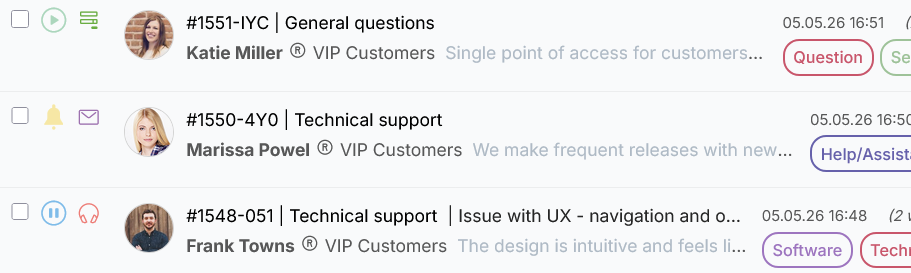

Cloud-Native Help Desk with No Setup Headaches
Sympoq integrates various communication channels into a single cloud help desk software: a customer and agent portal with support ticketing, email ticketing, an AI chatbot, a knowledge base, live chat, and a help web widget. Regardless of the channel, the unified operating environment ensures continuous tracking and management of all customer requests and inquiries.
The cloud delivery model provides access to software with a package of IT capabilities. Instead of installing an application on their own infrastructure, users can utilize a ready-made Help Desk Software-as-a-Service delivered in the cloud. Their flexibility and scalability make them a good choice for companies with dynamic capacity requirements.
Sympoq extends this approach one step further with extensive customization capabilities. The three pillars of an effective customer support are fully present: single point of contact, teamwork, and personalized workspace for all users.
Single Point of Contact
A single point of contact is a primary expectation of customers and serves as a central hub for all issues and requests. It's usually represented by a person or department.
Teamwork
Agents work together efficiently across requests from different products, services, or departments, minimizing the chance of missing important information or action.
Personalized Workspace
In customer service, personalization enhances the quality of experience by providing tailored interactions that rely on individual customer data and advanced analytics.
What is a Cloud-Based Application?
In terms of information technology, a cloud-based application refers to software, data storage, computer networks, and/or other on-demand services and resources that are available through the internet. Users and companies can take advantage of multiple IT resources without the need for infrastructure management. They typically pay only for the resources and services they use, ensuring lower operational costs and automated scaling of remote infrastructure according to operational needs. A closely related term is "cloud computing", referring to the set of technologies that enable access to these services.
What is a SaaS – Software-as-a-Service?
Software-as-a-Service (SaaS) is one of the three basic cloud delivery models, along with Infrastructure-as-a-Service (IaaS) and Platform-as-a-Service (PaaS). The SaaS model delivers applications that are hosted in cloud centers by a provider. Software applications form a separate layer positioned above the IaaS and PaaS models within the cloud stack. Users usually utilize applications on-demand and remotely over the internet using only a thin client device. They purchase and pay for utilization through a subscription pricing model. Common examples of software packages include: CRM, ERP, marketing automation, analytics, project management, and more.
What are the Benefits of Web-based Help Desk Software?
Web-based software is the most common type of software today and refers to any application that enables utilization using a browser and a computer network. Over the past few decades, its popularity has continued to grow, especially with the rise of SaaS. Following the development of technologies and the SaaS model, users gain a wide range of benefits, including:
- Cross-Platform Compatibility and Accessibility - usable on any device with a web browser, from any location,
- Scalability - accepts and handles a growing number of users while maintaining steady system performance, and
- Instant updates - all updates are performed on the servers, without the need to manage local devices and the platform.
SaaS Ticketing System
The integrated support ticketing system enables agents, as well as customers, to manage and resolve issues with built-in web forms. Customers only need to leave a description of the issue using a submission form, and the system takes the data into the database for further processing. They can attach files, screenshots, reports, and additional data required to speed up the resolution. Taking advantage of the cloud platform, the solution delivers an advanced SaaS ticketing system, providing ticket management across diverse service and support teams.
Team members with access permissions can track and resolve tickets from the browser of any web-connected device. This feature enables teams within a company to collaborate closely in executing everyday responsibilities. With robust automation in place, a smaller team can efficiently manage high ticket volumes while sustaining shorter resolution times.
Team managers and service supervisors have access to an expanded suite of ticket management tools with real-time monitoring of team performance, ticket tracking, and in-depth analytics reporting. These tools let them drill down into the root causes and drive continuous improvement in key performance indicators: first contact and average resolution time, first response time, wait time, and more.
Helpdesk Automation
The integrated automation utilities streamline the resolution process with rule-based ticket routing and assignment, SLA reminders, escalation triggers, and notifications.
AI-Driven Replies
During the resolution activity, agents receive the reply suggestions, which improves response times and further elevates the support experience.
Internal Ticket Submission
Agents can manually compose and submit tickets on behalf of customers. This capability is helpful for handling phone-in requests and generating internal tickets or tasks.
Extensive Customization
Organize tickets into logical categories, set up submission forms, add custom fields, arrange tagging for additional classification, design email templates, and more.
Event Log
The event log captures a complete history of each ticket's submission and resolution. This record helps track and analyze how the original request was created and how it was ultimately resolved.
Timely Notifications
Customers and agents receive real-time notifications and alerts for any system changes and modifications related to requests, tickets, and automated help desk actions.
Email Ticketing System
All users, including customers and agents, have the ability to utilize the email ticketing system, which relies on email messages, as a channel for communication. Customers usually send a standard message with a description of the request to one or more incoming email addresses. Afterward, the message is imported into the system and forwarded to the automation engine for further processing.
On the service and support side, team members manage tickets with simple email replies without worrying about back-end processes or the data consistency. Their replies are processed in the same way as those submitted through a web form.
Two-Way Communication
Recipients of system-generated email notifications may submit responses directly through their preferred email client, including Gmail, Outlook, and comparable platforms.
Reply Commands
Support agents are provided with an expanded set of in-message command options, enabling them to assign tickets, establish deadlines, share internal comments, and close tickets, all without leaving the email environment.
Conversion Standards
The system runs a powerful conversion utility aligned with email standards and protocols for parsing and delivery of new messages.
Attachments
Regular storage, sharing, and acceptance of multiple attachments are ensured during the email conversion, and sending messages.
Live Chat
Live chat speeds up the process by providing for a more natural and timely conversation, where a skilled agent can ask the right questions at the right time and direct a customer to the best solution. It provides a combination of real-time conversation with self-service options, enhancing the support experience for customers according to their preferences and capabilities.
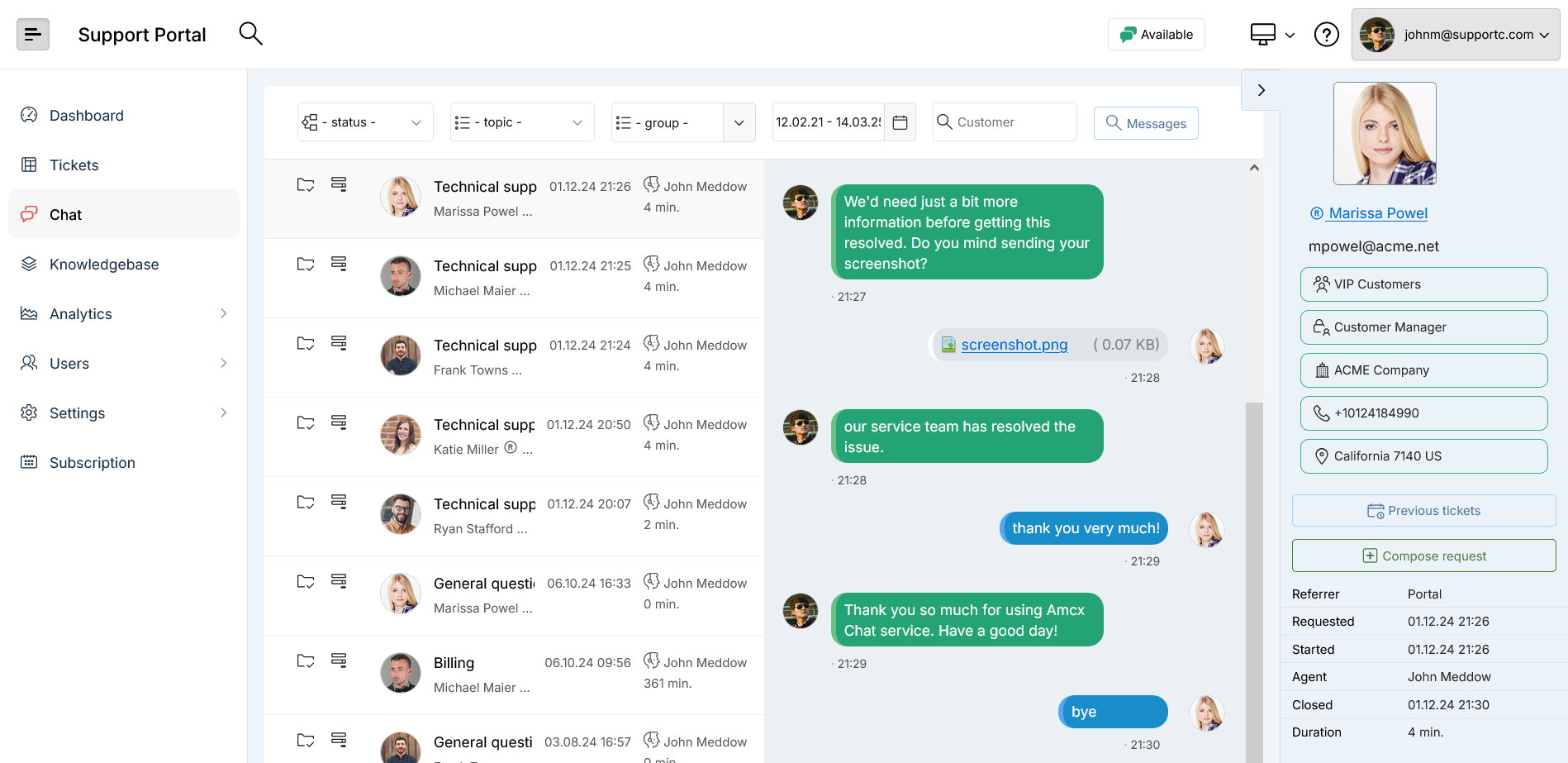
Message Streaming
Live chat appears as a web widget on the website or in the portal. When a customer opens the chat session, they are able to make a real-time message stream with support agents.
Agent Tool
On the agent's side, the overall layout is very much similar to what a customer sees. They are provided with additional information during the chat session: customer profile, previous tickets, and chat sessions.
Search Sessions
The agent can search chat sessions and messages using a set of keywords without the need to memorize previous solutions and answers.
Account Management
Account management covers the full lifecycle of user identities and associated profiles, controlling who can enter the application and what actions they can perform. This involves provisioning new user accounts, assigning initial roles, and modifying account details, such as permission changes or group memberships.
Private or Public Access
Sympoq can be set up as either an internal or an external system. Depending on the process or the type of service, access to the application can be granted only to registered customers and groups.
User Roles
Customers, agents, and managers are grouped by specific roles with the corresponding permissions. Following user roles, the system delivers personalized resources, features, and data.
Self-Registration with Approval
Guests and anonymous users start the registration process using the sign-up form. You can select which information they need to provide and optionally route registration for approval.

Fast Adoption and Intuitive User Interface
There is no need to install anything. Getting started is almost effortless, with a brief learning curve and no tailored training required. It's a flawless application that empowers support teams and improves the customer experience.