
Give Customers 24x7 Access to Help Desk with Self-Service Portal
Give customers a single destination to submit requests, track progress, find answers and solutions, and interact with your team at any time.

Centralized Customer Portal with Personalized Self-Service
The help desk self-service portal delivers a unified, multichannel support that keeps customers informed about their requests. It centralizes support ticketing, AI chatbot, live chat, and knowledge base into a single customer portal available 24x7. The portals is designed to scale as your customer base grows, helping your teams serve more users without increasing manual work.
- Customer dashboard - Provides summary information to customer managers and other members of a group or a company about all support history, request status, and communication with your team,
- Access control - For all help desk information, such as support tickets, live chat sessions, knowledge base articles, and chatbot data sources, the access list provides personalized access.
Reduce Support Costs
Fewer repetitive inquiries reach the support team, allowing them to focus on complex issues.
Improve Customer Satisfaction
Real-time communication and visibility into request status help customers feel informed and supported.
Take the Initiative
Analyze all customer requirements and requests to extract essential data for planning proactive support.
Support Ticketing
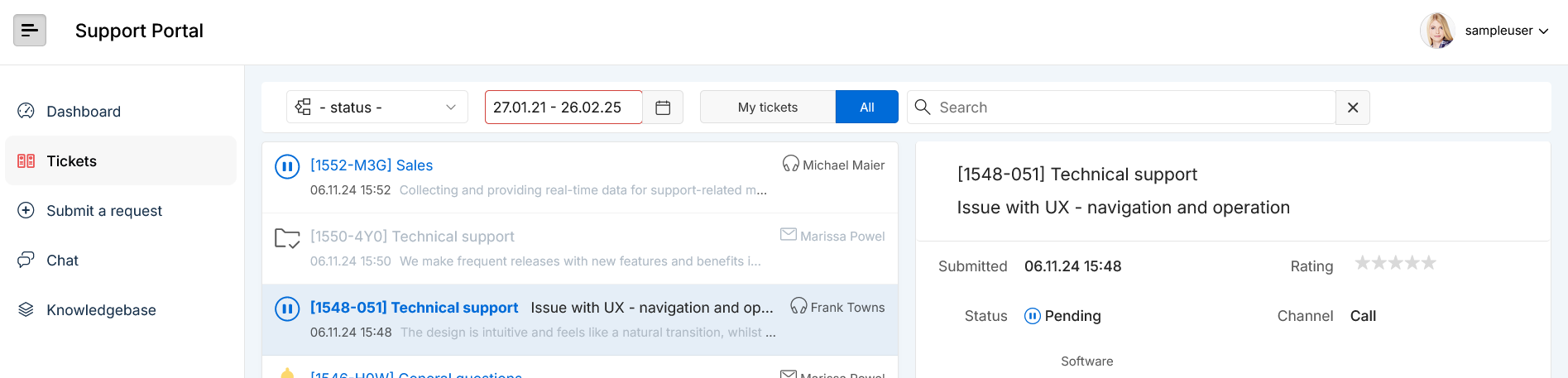
Customers are able to track information on submitted requests and all ticketing activity, including replies, attachments, and help desk actions. They enter the portal to submit a new request through a built-in form or via email ticketing. Afterward, the system creates a ticket and displays its status for real-time tracking with email and desktop notifications. Support agents manage tickets from their support portal, while customers can reply to messages, upload additional information, and close tickets from the portal interface or from an email software.
Ticket List
Requests and tickets are organized into a searchable ticket list. Customers can easily filter, search, view, and download information in Excel and PDF reports.
Action Log
Each ticket contains the action log with complete history of how the request was handled and resolved, including replies, messages, and attached files.
Customer Manager Dashboard
Customer managers can view all tickets belonging to the group they manage, along with summary reports.
Customer Feedback
Enables customers to rate the agent's answers and efficiency in resolving requests.
AI Customer Service Chatbot
AI-driven tool that answers questions using your internal documents, guides, and support experience
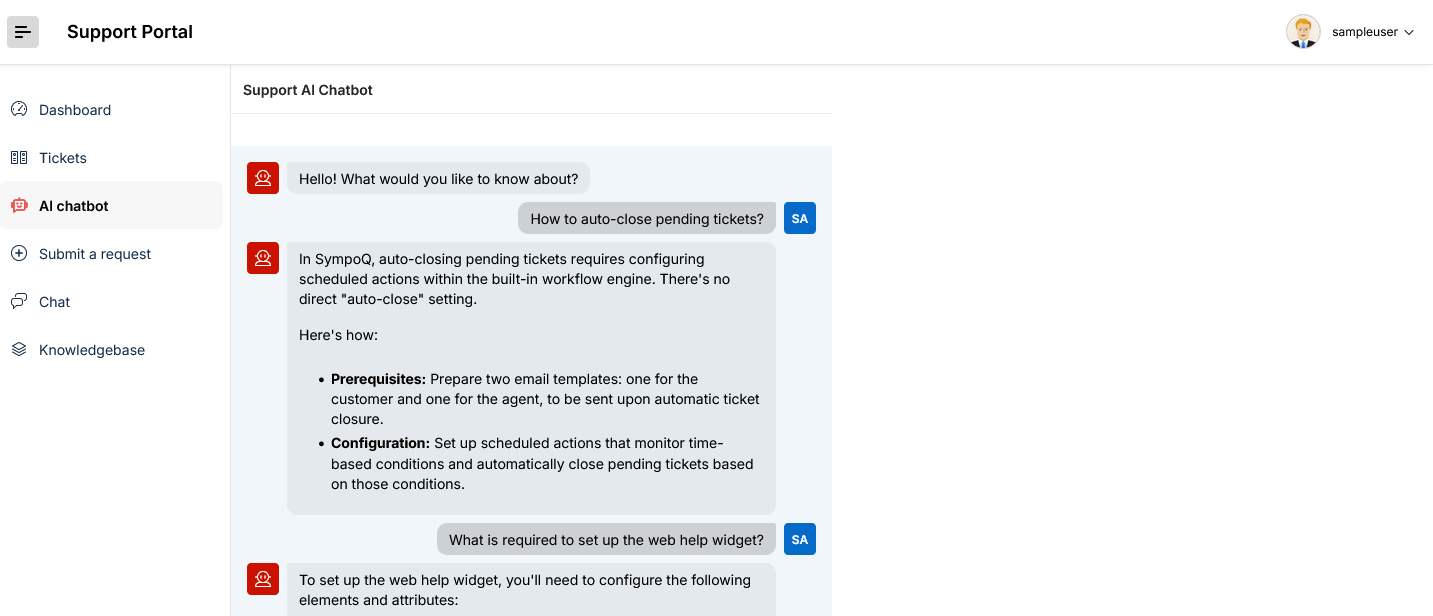
The AI chatbot provides real-time and consistent responses to customer queries, additionally improving self-service capabilities. By handling multiple conversations simultaneously and operating around the clock, you'll enhance the customers' experience and identify common questions.
Data Sources
Add various data sources to provide the AI chatbot with the most relevant information. Easily upload web URLs and PDF files to extract important information required to respond to customer queries: list of frequently asked questions, internal documents, troubleshooting guides, and more.
Chatbot logs
Gain insight into the conversation logs to refine the chatbot's capabilities and optimize its performance over time. Utilize fine grained access to individual chatbot sessions, and customer inquiries sent to the Chatbot.
Integrate with Web Widget
Set up the chatbot title, the welcome message, and enable integration with the Help Web widget. By allowing your website visitors access to AI Chatbot, you'll extend the self-service capability and the communication with customers.
Enable AI agent replies
Enable uploaded data sources to serve as the basis for AI generated replies to customer tickets. Your internal documents are the best source of information needed to effectively respond to recurring customer queries.
Knowledge Base and FAQs
Organize collective knowledge and document best practices
Knowledge base is a central hub where users can find information about services, products, solutions, the company, or other relevant topics in an organized form. Information is categorized into different sections with varying access levels for knowledge base categories and articles.

Internal, External, and Public
Using access permissions for knowledgebase categories and belonging articles, three different types of knowledge bases can be provided, dedicated to agents, registered groups of users, and guest users, respectively.
Smart Search
Users can search for solutions in the knowledge base using free text questions and get a ranked list of the recommended articles.
Rating Articles
The knowledge base articles can be rated, enabling the list of the most popular and recent articles.
Add and Edit Articles
Create article content using the HTML-rich text editor.
Offer 24×7 access to help desk with a simple layout and personalization capabilities to reduce the total cost of support.