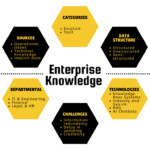
Presenting knowledge to employees and clients has always been a major challenge for enterprise companies. In our previous article Enterprise Knowledge: Categorization, Structure, Management, and Challenges, the enterprise knowledge management is presented in general, including categorization, data structures, challenges, and relation to RAG techniques and AI chatbots. As one of the solutions for knowledge representation, the emergence of AI chatbots powered by Large Language Models (LLMs) is becoming increasingly popular.
Rise of LLM
The main advantage of LLMs is their outstanding ability to understand natural language. When it comes to their application in a regulated enterprise environment, they are limited by several challenges, though. The primary ones are the lack of access to specific domain knowledge and their tendency to hallucinate.
In the business world, where accuracy and reliability are imperative, relying on the inherent, parametric knowledge of an LLM is not enough. The solution appears in the form of the Retrieval Augmented Generation (RAG) systems.
The primary task of the RAG is to provide the LLM with dynamic access to up-to-date, proprietary information from the organization. This ensures that the information is based on real corporate data, without the need for constant and expensive retraining of the model.
RAG systems are inherently context-aware, as they allow users to ask a complex question and receive a direct, formulated answer in natural language. For example, if a user in a customer support system submits an AI chatbot a query on how to reset a password, the system finds instructions from the IT manual and provides a step-by-step answer.
Combining Enterprise Knowledge with a RAG System
The integration of the RAG architecture requires the transformation of operational processes within the organization. Eventually, it ensures that AI chatbots provide precise and informative answers based on valid enterprise knowledge.
Common domains of application for RAG systems are as follows:
- Customer support: Used for a limited automation of customer support tasks. It involves extracting information from internal knowledge bases, FAQ documents and troubleshooting guides. With this information, the AI chatbot is provided with a basis for natural language responses.
- Legal: Since accuracy and reliability are crucial in the legal domain, RAG is applied to analyze statutes, regulations, and court rulings. Additional applications include automating contract review and generation, ensuring regulatory compliance, and preventing generation of legally incorrect claims.
- Financials: RAG models are suitable for analyzing financial reports and business processes, as they can extract data from complexly structured documents. This offers organizations a scalable solution for comprehensive data analysis and facilitates informed decision-making.
Simple RAG pipeline
RAG in enterprise environments retains the basic approach of a standard knowledge base, including data indexing, searching, and generating answers. System requirements are significantly more complex than in the standard knowledge bases, though.
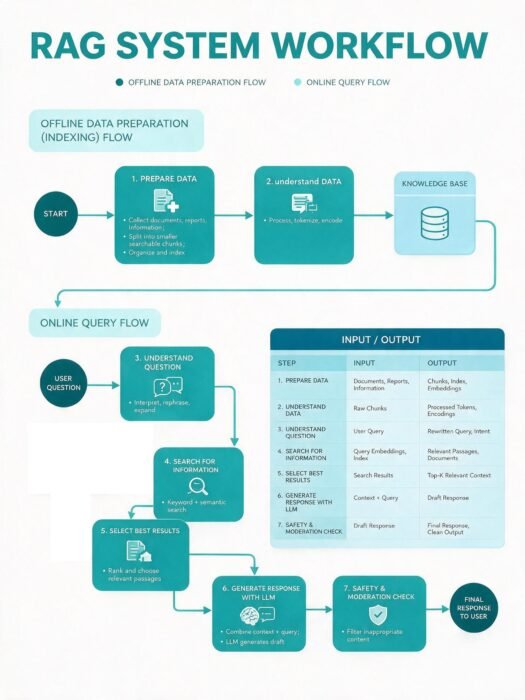
The RAG pipeline involves additional layers of complexity due to fragmented enterprise knowledge. The layers are responsible for data security, their integration, and advanced semantic understanding. The entire workflow of an advanced RAG system in a business environment executes in the following steps:
- The cycle begins with the offline phase of entering and processing raw enterprise data, i.e. indexing and storing data. After filtering, chunking, generating embedding representations, and additional transformations, data sources are further organized through indexing mechanisms, such as BM25, HNSW, and graph databases.
- In the online phase, the user query first passes the understanding process. The query string is first decomposed, then reformulated, and further expanded for more precise semantic alignment with relevant information.
- The system then performs the information retrieval phase by combining different search methods, including lexical and semantic approaches.
- The resulting documents go through a fusion and re-ranking phase, where the most relevant reference documents are extracted by merging and re-ranking.
- The generative part of the system involves recognizing the user’s intent and directing the query to the appropriate knowledge source. Relevant documents, together with the user’s query and the system prompt, are passed to the LLM, which generates a response based on the provided context.
- The final phase includes content moderation. The security mechanism optionally rejects inappropriate or potentially dangerous requests before delivering the response to the user.
RAG Benefits
The adoption of the RAG brings a number of benefits to organizations:
- Access to internal and up-to-date knowledge: RAG gives LLMs access to and use of current, specialized information from environment-specific databases.
- Reduced search time and increased productivity: Aggregation of knowledge into a single coherent answer reduces the time employees spend searching for information.
- Transparency, validity, and trust: Answers generated in enterprise RAG typically contain citations and references to the source documents from which the information was taken.
- Adaptability and scalability: RAG offers a much more agile and cost-effective way to adapt LLMs to specific business needs. Organizations can simply update an external knowledge base, and the system automatically starts using that information, without the need for expensive retraining or tuning.
Challenges and Limitations
The implementation of RAG systems in complex, real-world enterprise environments faces certain limitations and challenges. They are very similar to challenges described in the common knowledge retrieval and acquisition from the previous article:
- Data security is crucial in business environments and represents a critical component of enterprise RAG. There are two main challenges related to security:
- The risk of unauthorized access to sensitive data arises during the information retrieval process. In a business environment, data is highly confidential and subject to regulatory frameworks, such as GDPR or HIPAA. A RAG system can accidentally return and reveal highly confidential documents to an unprivileged user if authorization rules are not explicitly specified in the search process.
- Prompt injection: RAG systems are vulnerable to prompt-based attacks and intentional data poisoning. Attackers can inject malicious or manipulative texts into the corpus of documents. When a retriever retrieves a document and passes it to an LLM, the model can be tricked into generating malicious content, revealing private data, or performing unauthorized actions.
- Balancing the amount of retrieved knowledge greatly affects the efficiency of the RAG system. Failure to comply with this requirement has two consequences:
- Under-retrieval occurs when the system misses key documents, so the model’s response remains incomplete, or the generator relies on its over-trained parameter memory, which increases the likelihood of hallucinations.
- Over-retrieval occurs when the system, in an attempt to increase responsiveness, retrieves too many documents. This problem increases computational costs and latency while introducing a large amount of noise into the prompt. Too many documents degrade the quality of the final response, making the model become overwhelmed by data.
- Highly dynamic enterprise sources: Documents containing enterprise knowledge change daily. Real-time updates require complex architectures for incremental index updates. If there is a delay in the process, the vector index becomes outdated, resulting in inconsistencies between the currently available and the offered knowledge.
- Lack of personalization: Basic RAG systems treat the user query as an isolated text string, ignoring the deeper context of the user. The system then does not know who is asking, in what specific business context it is asked, or what the user’s real goal is.
For example, to an identical query about the performance of a certain software system, a standard RAG will return exactly the same answer to a software engineer and a sales manager. For both roles, their actual information needs require a very different level of technical detail. As a solution to the issue, the personalized RAG appears. It enables high personalization of content, i.e., adapting the search and generation process based on the user’s role, individual preferences, and interaction history.