
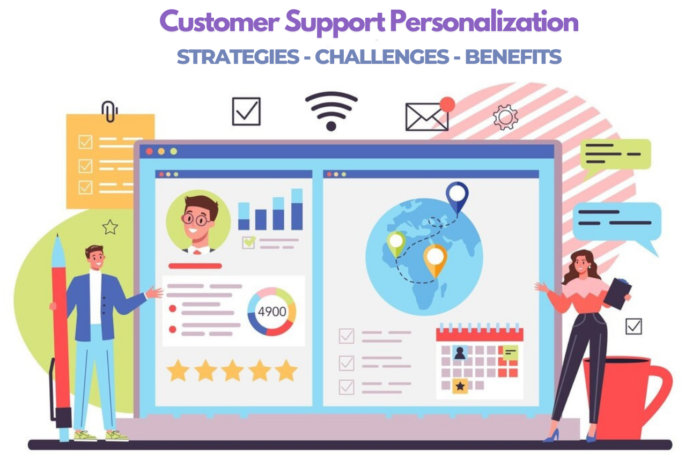
In our previous article about general customer service, contact centers, and CRM, we emphasized the importance of quality of service and the omnichannel approach to improve the customer experience. Contact center act as the primary interface between a business and its customers, making their operational efficiency and service quality critical. One of the fundamental aspects that enhances the quality of service is personalization, which involves tailoring interactions and solutions based on individual customer data and preferences.
Personalization is no longer a “nice‑to‑have” but a core differentiator that can make or break loyalty. Research consistently shows that customers are more likely to repurchase, recommend, and forgive mistakes when they feel a brand “knows” their requirements.
Regardless of whether the contact center is supported by feature-rich support software as a part of a CRM system or a simple help desk system, it benefits from the personalization of customer service. For contact centers, personalization is the bridge between operational efficiency and emotional connection. It transforms service from transactional to relational, turning every interaction into an opportunity to strengthen trust. In this article, we will describe the key personalization benefits, challenges, strategies, and technical capabilities.
Key elements of personalization
Personalization in contact centers is driven by advanced data analytics provided by the supporting software, e.g. CRM systems, help desk software, or customer support software. The key elements include:
- Data Integration: Aggregating from various sources, such as interaction history, purchase behavior, and feedback, to create a comprehensive customer profile.
- Predictive Analytics: Utilizing machine learning algorithms to predict customer needs and behaviors based on historical data.
- Personalized Scripts: Develop customized interaction scripts based on individual context and preferences. This is commonly utilized with chatbots or similar utilities.
Technical benefits
Incorporating personalization into contact center operations offers several technical benefits:
- Increased Efficiency: Personalized interactions reduce the need for repetitive questioning, as agents have immediate access to relevant customer data.
- Improved Accuracy: Tailored responses based on accurate data analysis enhance the precision of the information provided.
- Enhanced Customer Insights: Detailed data analysis provides deeper insights into customer behavior and preferences, enabling more effective targeting and engagement strategies.
Challenges in implementation
Despite its advantages, personalization in contact centers presents several technical challenges:
- Data Privacy and Security: Ensuring compliance with data protection regulations, such as GDPR, and securing data against breaches.
- System Integration: Integrating various data sources and available software to create a unified customer profile can be complex and resource-intensive.
- Scalability: Maintaining consistent personalization as the customer base grows requires robust infrastructure and scalable solutions.
- Agent training: Even the best tools fail if agents don’t know how to use them effectively. Training should focus on interpreting data insights and applying them naturally in conversation.
Technical capabilities for effective implementation
To implement effective personalization, businesses can adopt the following technical capabilities:
- Advanced software systems: Deployment of CRM or help desk software with capabilities for data integration, analytics, and communication.
- Artificial Intelligence (AI) and Machine Learning (ML): Leveraging AI and ML technologies and algorithms to analyze customer data and automate interactions.
- Real-Time Data Processing: Ensures up-to-date customer profiles and immediate response customization.
- Omnichannel Integration: Ensuring that the acquired data are consistent across all interaction channels, such as phone, email, chat, and social media.
Conclusion
Personalization enhances the quality of service quality by providing tailored interactions based on individual data. It is not just about technology — it’s about orchestrating data, tools, and human empathy into a seamless customer experience. By addressing technical challenges and adopting advanced strategies, businesses can ensure high-quality, personalized service in their contact centers, driving customer retention and growth.
The future belongs to organizations that can predict requirements, needs, act proactively, and make every customer feel like the only customer.

