General settings
This section lets administrators customize the overall behavior and appearance of their Sympoq help desk portal. They can set general options such as time zone, date format, permissions for certain account resources, and to configure the login page.
Account title and layout theme

To set the account title and layout theme, enter the following values:
- Account title: Displayed in the header of account pages.
- Layout theme: Choose from several background themes that affect navigation colors, titles and button styles.
Time and Date
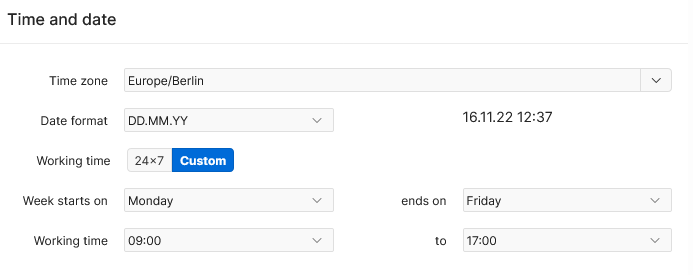
The Time and Date section allows you to adjust the time correction and set the preferred date/time format:
- Time zone: Select your local time zone to adjust time correction.
- Date format: Choose preferred date and time display format.
- Working hours: Set to either Custom or 24/7. This impacts Service Time Measurement values (Deadline, Response Time, Resolution Time), and running the Workflow Scheduled actions. If Custom is selected:
- Define start and end days of the working week with Week starts on and ends on.
- Set daily Working hours.
Guest access
Depending on your organization's requirements, choose between an internal or external help desk. You can close the entire site to guest (anonymous) visitors or allow them to submit a request, use the public knowledge base article, and register themselves as customers/end-users.
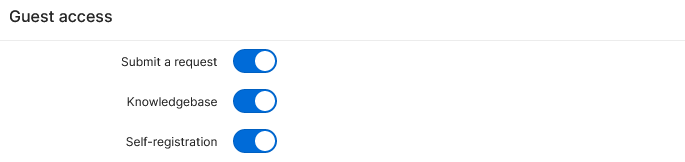
Click the toggle switch to enable or disable access to selected pages and resources from the Login/Portal page for guest visitors:
- Submit a request: Public request submission form.
- Knowledgebase: Public knowledgebase articles.
- Self-registration: Customer's self-registration (Sign up) form.
Info
The initial settings allow access to requests submissions, public knowledgebase categories and articles, as well as the customer self-registration.
Social Sign-in
Social sign-in is a single sign-in for customers. Using existing login information from a social network provider like Google or Microsoft, the customer can sign into your site instead of creating a new account. This simplifies registrations and logins for customers.
To set up the social-sign in, enable or disable the following available social logins:
- Google sign-in, and
- Azure/Office 365 sign-in.
After the social log-in is enabled, the corresponding log-in button(s) will be available on the public Login page, below the Login form.
If you want the customer to have only the Social sign-in options on the Login and registration page, you need to disable the usual self-registration with email by unchecking the Self-registration.
However, both sign-in modes (Self-registration and Social sign-in) can remain enabled. There is also a third mode, where customers can access your site after being registered manually in the Users -> Customers, Add Customer section, which can also co-exist with the first two modes.
Warn
Please note that agents and site administrators must use the regural Login form.
Info
The initial settings disable Social-sign in.
Self registration settings
Self-registration settings manage the way anonymous visitors can register themselves to Sympoq site as registered customers.
The Join form (Customer self-registration) can be accessed via the Join link from the Login page. In order to provide the customers' self-registration and the corresponding button/link, the overall self-registration process must be enabled in the previous Guest access section.
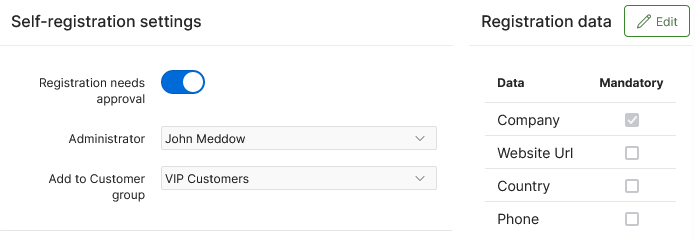
The following options are available:
- Registration requires approval: Click the toggle switch if the customer self-registration requires approval by the site Administrator. Otherwise, each self-registered visitor is automatically registered as a customer. If registration is needed, the following settings should also be set:
- Administrator: If your account has multiple administrators, choose which of them should be notified about the new self-registration
- Add to Customer group: The self-registered customer will be added to the selected Customer group.
Registration form fields
The Join (Customer self-registration) form contains the following mandatory registration fields:
- Name (full), and
- Email address.
Along with the system enabled registration fields, you can add the following custom fields:
- Company name
- Website URL
- Location data: Country, Region, Address, ZIP/Postal code, City
- Phone
- Mobile, and
- External ID.
To edit the Custom registration form, click the Edit button and edit the popup form "Registration data". To add a new registration data:
- Click the "Add Row" field
- Choose a new field from the select list, and also choose whether the field should be mandatory or not - check or uncheck the Mandatory checkbox
- Click the Save button.
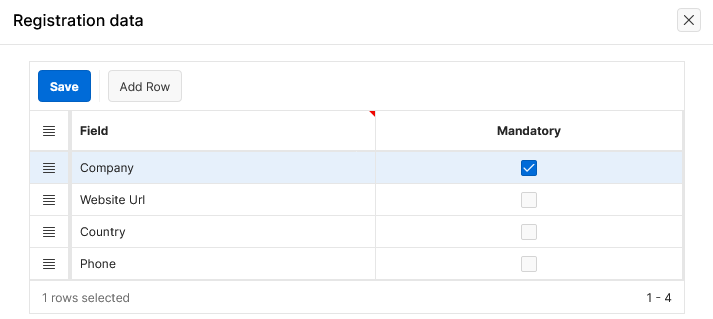
Repeat steps above to add more fields to the form.
To remove a custom field from the registration form:
- Click the Actions menu icon in front of the field you wish to delete
- Choose Delete Row from the action list
- Click the Save button.
Login page
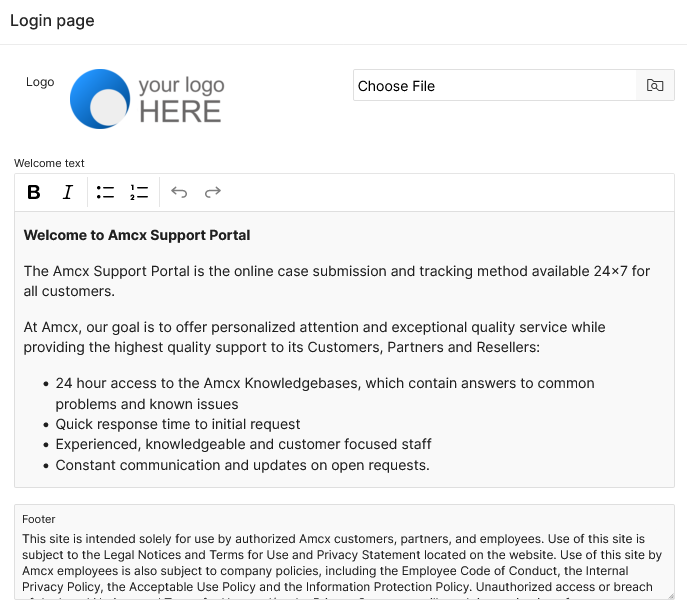
Edit the following values to adjust the Login page:
- Show Logo: Enable or disable the logo visibility.
- Choose File: Select the image file from your local disk. If enabled, the logo image is displayed in the Login page header. Please, note the following restrictions:
- Image types: jpeg/jpg, png, gif
- Maximum file size: 300 KB
- Recommended width and height: up to 200px x 60px.
- Welcome text: Free text displayed on the Login page.
- Footer: Free text displayed in the Login page footer.
Success
To confirm changes, click the Save button.
About languages
Sympoq automatically detects and displays the interface in the user's browser language. In addition to English, supported languages include Spanish, Dutch, Arabic, German, and Portuguese. No manual selection is required by administrators or users; the system adapts based on locale settings. For example, if the user's browser language is set to Spanish ('es'), that user will see the Spanish version of the application.
Guides on how to change the default language in different browsers: