Ticket List
The Ticket List provides a compact view of every ticket matching current filters. From there, agents can browse queues, narrow down the list using search controls, navigate to ticket details page, search messages, download or print, and execute bulk operations.

The page is organized into three main regions:
- Queues: Browse queues you have access to.
- Search and Filters: Narrow down tickets by status, topic, date, customer, and more.
- Ticket Grid: View key ticket details and navigate to individual tickets.
Queues
The Queue list appears on the left side of the page. Along with each queue name, the number of open tickets in the Queue is displayed, e.g., "Support (7)".
To navigate through queues, click a queue name. Afterward, the ticket list is reloaded to show the corresponding tickets.
Search and Filters
Use the filter panel above the grid to search and filter data:
- Status: New, Working, Pending, Closed
- Topic: Topic defined in settings
- Customer Group: Group name defined in settings
- Assignee: Select a specific named agent
- Submission Period (Calendar): Choose start and end dates
- Overdue: Toggle to show only past-deadline tickets.
To search tickets, enter a string in the Search field to scan across and press Enter key:
- Ticket ID
- Customer name or email
- Subject
- Tags, and
- Description.
Ticket Grid
Tickets appear in descending order by submission time. Each row is clickable and links to the ticket's details page. Columns include:
- Checkbox: Select rows for Bulk action
- Status: Visual cue for ticket state
- Channel icon - Indicates
- Web form
- Email client
- Help widget
- Request composed by agent
- ID and Topic: The ID and the topic concatenated with Subject (if the Subject is enabled).
- Submission date/time
- Customer: If the customer is registered, the name is concatenated with the registered mark "®"
- Description: Summary of the description
- Assignee and the deadline.
- Tags: Any applied tags.
Tip
Hoover over the Description to see the full text in a tooltip.
Bulk Actions
Bulk actions allow you to perform predefined actions on several tickets at once using the predefined action forms:
To perform a bulk action:
- Click one or more checkboxes at the beginning of a row to select tickets, or click the header checkbox to select all rows. Afterward, the Bulk actions menu appears.
- Click the corresponding action button
- Proceed with the action as described below.
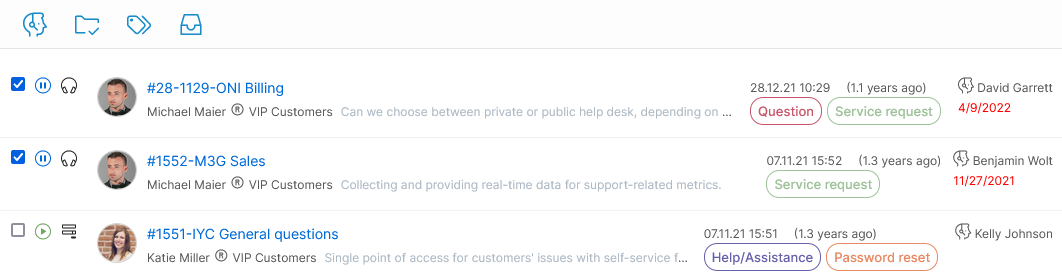
If you want to cancel any of the bulk actions, click Cancel in the corresponding action form.
Tip
To deselect one or all tickets, click the header checkbox.
Warning
The bulk actions do not perform Automation rules, nor send email notifications.
Assign

To assign tickets to a named agent:
- Select a named agent
- Optionally set the Deadline using the calendar control: choose the date, hour and minute, and then click "Close" within the calendar.
- Click Assign.
Note
The named agent must have access to the queue the ticket belongs to. If they do not, the assignment fails.
Close

To close tickets, click Close.
Tag

To tag tickets:
- Select one or more tags
- Click Tag.
Move

To move tickets to a queue:
- Select the queue
- Click Move.
Note
If the ticket is already assigned to a named agent, ensure that the agent has access to the queue.
Search Messages
In addition to searching the list with filters and search fields, you can also search all messages across all tickets. For example, you can search for a text in customer replies, agent replies, and in internal agent comments.
Click Messages button below the queues, enter the term and hit the Enter key.
The results grid will display each message containing your term.
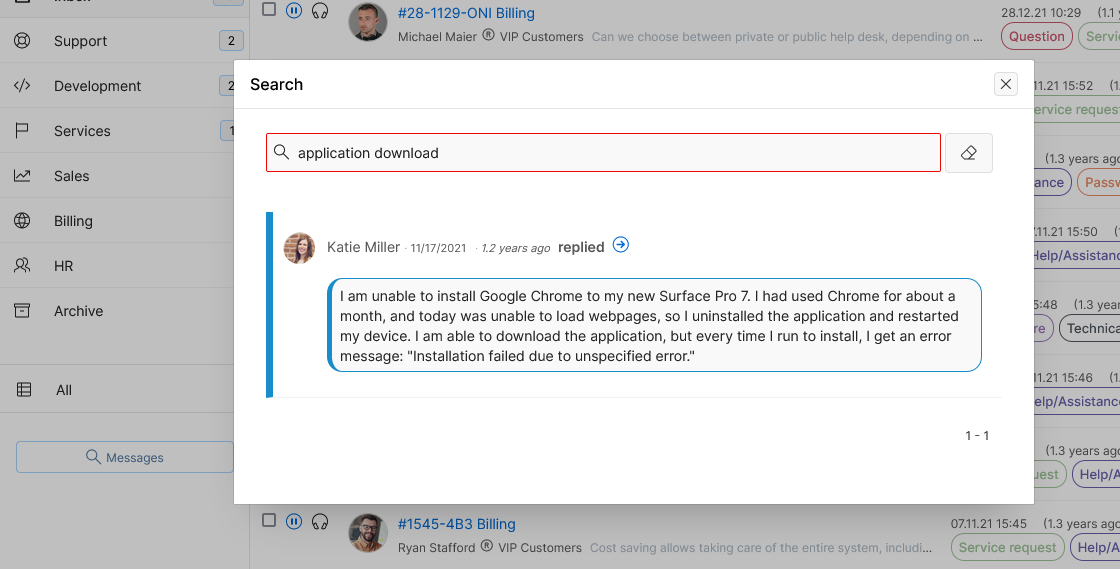
Click the link icon to jump to the ticket details page.
Exporting and Printing
You can export or print your current grid view:
- Click PDF or CSV button
- Use exports to perform offline analysis or share snapshots with stakeholders.
- The exported file preserves filters, column layout, and pagination.