Email templates
Email notification templates control the content and layout of messages sent to customers and agents. These messages are used for automated notifications of agents and customers when certain actions are performed, such as:
- New ticket submissions
- Common agent and customer actions, e.g. ticket reply, assignment, and when a ticket is closed
- Scheduled actions, e.g. ticket reassignment and escalation
- Registration of new users in the system.
Along with the native email delivery, the messages also appear as pop-up notifications in the agents' dashboards.
Once a template is set, the detailed settings for utilization of email notifications can be found in:
- Default notifications in the ticket processing
- Automation rules
- User registration: agent and customer.
You can customize system-provided templates or create your own to align notifications with your branding and workflow:
- System or predefined templates are required for core operations. These templates are editable, but not removable.
- Custom or user-created templates can be associated with advanced automation rules.
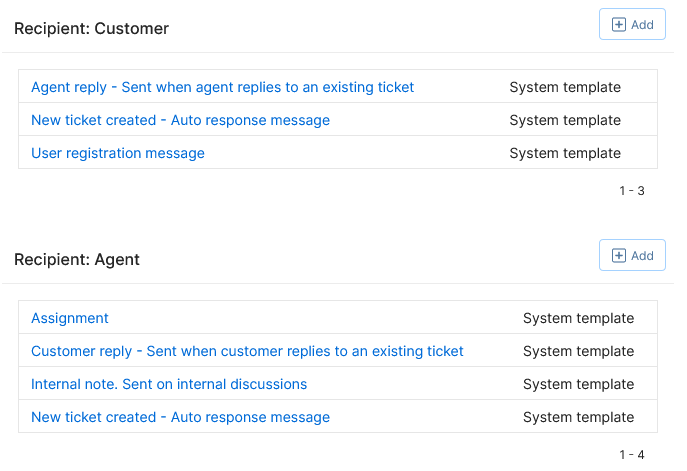
Accessing the Email Templates Screen
- Navigate to Settings > Email templates.
- To edit a template, click the template name, or click the [+] Custom template to create a new template.
Creating and Editing Templates
The details form contains the following data:
- Metadata
- Name: Enter a descriptive label for your internal reference.
- Recipient: Choose whether the notification goes to a customer or an agent. This option appears only for custom templates.
- Message content - Defines what the recipient sees in their inbox:
- Subject: Enter the email's subject line.
- Body: Edit the main content.
- Add placeholder - Select a variable placeholder that inserts a value from the ticket data.
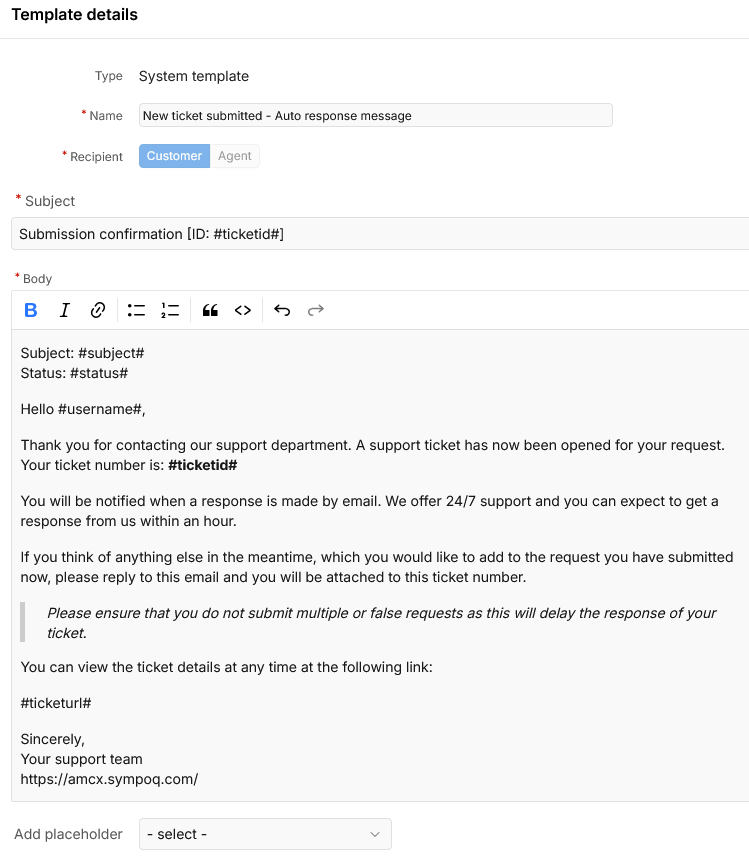
After editing, click the Save button to return to the template list. In the list, click the preview icon to check the template and show an example of the receiving message.
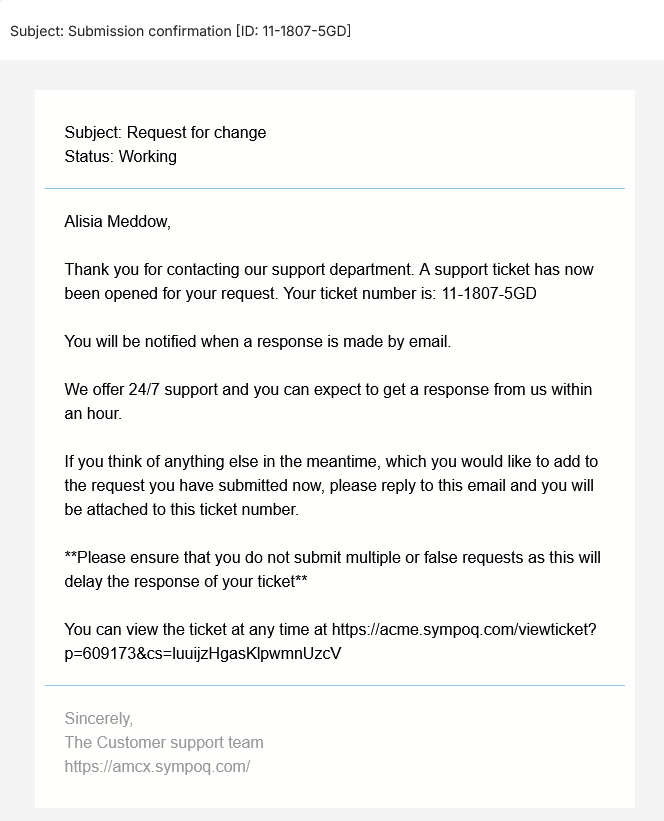
Variable placeholders
Variable placeholders inject dynamic ticket and user data into email notifications. Placeholders enclosed in the sign # are replaced with real-time values when the email is sent.
To add a variable placeholder to the template, select a placeholder from the drop-down list in the Add placeholder below the Body. After the placeholder is selected, it initially appears at the top of the Body. Afterward, you can move the placeholder anywhere within the body.
Common placeholders
The following placeholders can be added to the subject and body for both customer and agent templates:
| Placeholder | Injects | Example |
|---|---|---|
#subject# |
Ticket subject | Help needed |
#ticketid# |
Ticket ID | 11-1807-5GD |
#created# |
Submission date/time | 31-Aug-26 12:11 |
#username# |
Customer full name | Marissa Powel |
#usermail# |
Customer email | mpowel@acme.net |
#usergroup# |
Customer group | VIP |
#status# |
Current ticket status | Working |
#assignee# |
Assigned agent | John Meddow |
#deadline# |
Deadline date/time | 01-Sep-26 12:11 |
#closed# |
Closure date/time | 04-Sep-26 09:33 |
#priority# |
Ticket priority | Normal |
Tip
Date and time data take their format from General settings > Date and time.
Body-only placeholders
These placeholders are valid only within the email body section:
| Placeholder | Injects | Example |
|---|---|---|
#description# |
Ticket description (message) | I'm having an issue with the password reset feature. The system doesn't accept the new password. |
#reply# |
Latest reply (Customer or Agent) | The issue you reported has been fixed. Please try now. |
#attachments# |
Attachments (links) | screenshot.png |
#ticketurl# |
Link to ticket detail page (1) | https://acme.sympoq.com/viewticket?p=609173&... |
#internal# |
Agent internal comment or note (2) | Can you please check into this? |
Note
(1) #ticketurl# in customer templates injects linke to the secure ticket view page.
It can be used only in the Customer type of templates.
(2) #internal# applies exclusively to the Internal note template.
User registration template
The following placeholders are valid for the user registration:
| Placeholder | Injects | Example |
|---|---|---|
#login# |
Username (login) | rstafford |
#password# |
Initial password | vW0oi7e(k |
#username# |
Full name (Customer or Agent) | Ryan Stafford |
Examples
Notifications for customers
New ticket submitted
| Data | Text |
|---|---|
| Subject | Submission confirmation [ID: #ticketid#] |
| Body | Hello #username#, Thank you for contacting our support department. A support ticket has now been opened for your request. Your ticket number is: #ticketid# You will be notified when a response is made by email. We offer 24/7 support and you can expect to get a response from us within an hour. If you think of anything else in the meantime, that you would like to add to the request you have submitted now, please reply to this email and you will be attached to this ticket number. Please ensure that you do not submit multiple or false requests as this will delay the response of your ticket Subject: #subject# Status: #status# You can view the ticket at any time at the following link: #ticketurl# Sincerely, The Helpdesk Team |
Agent reply
| Data | Text |
|---|---|
| Subject | Reply to ticket [#ticketid#] |
| Body | #reply# #attachments# For the full details visit: #ticketurl# |
User registration message
| Data | Text |
|---|---|
| Subject | Registration credentials |
| Body | Hello #username#, You have been registered at our help desk with the following credentials: Username: #login# Password: #password# Login page: https://acme.sympoq.com/ Once you log in you should change your password by choosing "My profile > Change Password". Sincerely, The Helpdesk Team This message was sent from a notification-only email address that does not accept incoming email. Please do not reply directly to this message. |
Notifications for agents
New ticket submitted
| Data | Text |
|---|---|
| Subject | New ticket: [#ticketid#] #subject# |
| Body | A new ticket has been created: Customer: #username# <#usermail#> #description# To check the details, log in to the Support Portal. |
Assignment
| Data | Text |
|---|---|
| Subject | Assignment: [#ticketid#] #subject# |
| Body | The ticket [#ticketid#] has been assigned to you: Customer: #username# <#usermail#> Submitted: #created# Deadline: #deadline# #description# To check the details, log in to the Support Portal. |
Customer reply
| Data | Text |
|---|---|
| Subject | Reply: [#ticketid#] #subject# |
| Body | #username# #usermail# replied: #reply# #attachments# To check the details, log in to the Support Portal. |
Internal comment
| Data | Text |
|---|---|
| Subject | New internal comment: [#ticketid#] #subject# |
| Body | Customer: #username# <#usermail#> Subject: #subject# Status: #status# #internal# #attachments# To check the details, log in to the Support Portal. |